AI vs. Traditional Web Design: What's Different, What's Better, and What Still Needs a Human
AI hasn't replaced web designers. It's replaced the parts of web design that never needed a human in the first place.
Introduction
The conversation around AI in web design tends to be polarized. One side says AI will replace designers entirely. The other says AI output is generic garbage that can't compete with human creativity.
Both are wrong.
The truth is more practical: AI excels at specific parts of the design process and falls short at others. Understanding which is which saves you from either overpaying for human work that AI handles better — or trusting AI with decisions that genuinely need human judgment.
The Traditional Web Design Process
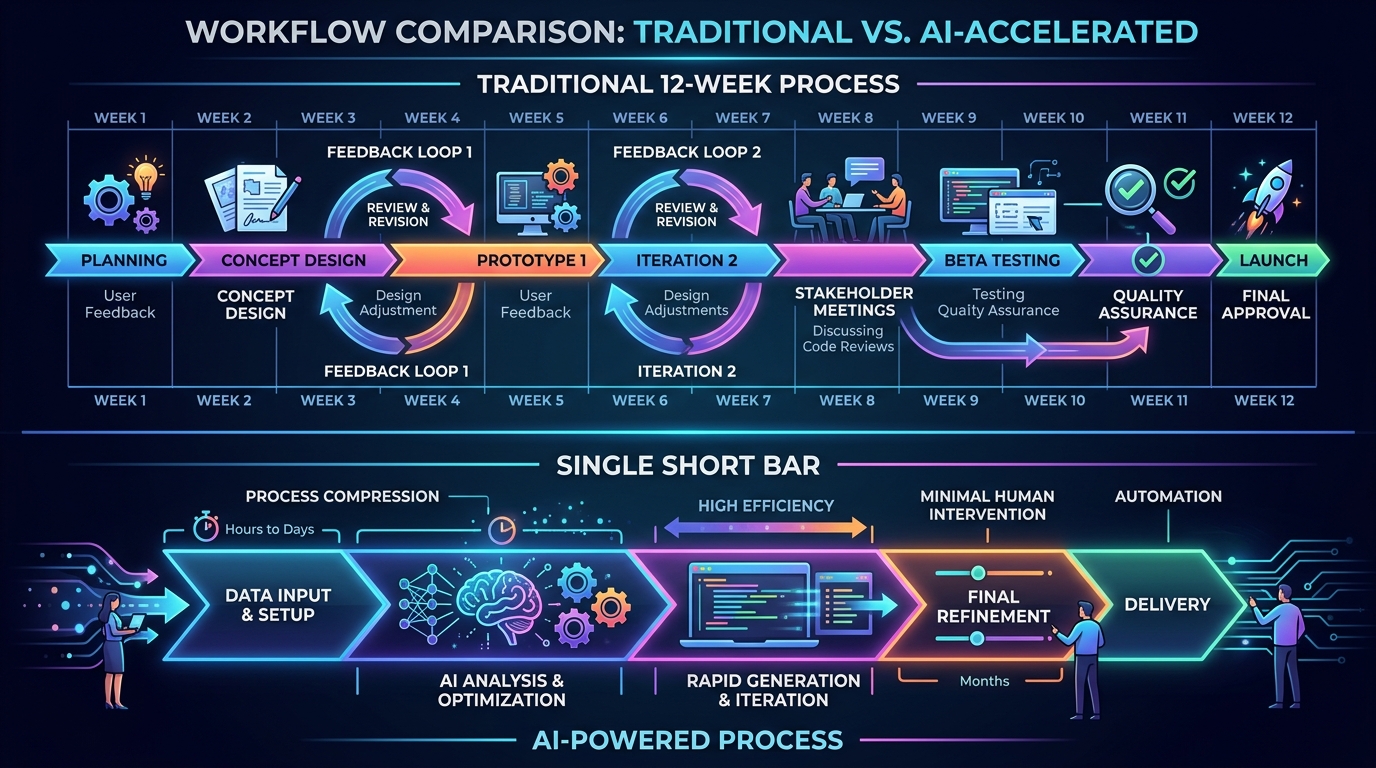
Traditional web design follows a well-established workflow:
- Discovery — Meetings to understand goals, brand, audience
- Research — Competitor analysis, user research, content audit
- Wireframing — Structural layouts showing page organization
- Visual Design — High-fidelity mockups with colors, fonts, imagery
- Feedback & Revisions — Client reviews and design iteration
- Development — Building the actual site from approved designs
- QA & Launch — Testing and going live
Each step involves human decision-making. Quality depends on the designer's talent and understanding of your business. Timeline depends on how efficiently you and the designer communicate.
Average timeline: 6–16 weeks Average cost: $5,000–$50,000
The AI Web Design Process
AI tools like Redesignr compress most of this into a single step:
- Input — You provide your existing website URL
- Analysis — AI reads your content, layout, colors, brand signals
- Generation — AI produces a modernized redesign based on current standards
- Review — You evaluate the result
No meetings. No wireframes. No revision cycles. No waiting.
Average timeline: Minutes Average cost: $0–$200
Where AI Wins
Speed
The most obvious advantage. A traditional redesign takes 2–4 months. An AI redesign takes minutes. For businesses losing customers to an outdated site, that time difference has a real dollar value.
Consistency
Human designers have off days. They get fatigued on large projects. Section 1 looks great but section 15 has inconsistent spacing. AI applies the same standards uniformly to every element on every page.
Data-Informed Design
A human designer might choose a layout because it looks good to them. AI chooses layouts because they're statistically proven to convert. Button placement, CTA positioning, social proof layout — AI draws from patterns across thousands of high-performing websites.
Cost
AI has eliminated the minimum budget barrier for professional design. A business that couldn't afford a $10,000 agency engagement can now get comparable visual quality for under $200.
Iteration Speed
Don't like the result? Regenerate. Want to try a different direction? Regenerate. With traditional design, each iteration costs time and often money. With AI, iterations are instant and free.
Where Humans Win
Brand Strategy
AI can modernize how your brand looks. It can't define what your brand is. Positioning, messaging, target audience, brand personality — these are strategic decisions that require human understanding of your business and market.
Original Creative Concepts
AI is excellent at applying known patterns. It's weaker at creating something genuinely novel — a unique illustration style, a layout that breaks conventions intentionally. That requires human creativity.
Complex Problem Solving
Custom booking systems, multi-step application flows, interactive calculators, personalized user experiences — engineering problems that require human architects and developers.
Emotional Nuance
A luxury brand's site needs to evoke a specific feeling. A children's hospital site needs to feel reassuring. A memorial site needs sensitivity. These emotional registers require human judgment that AI doesn't reliably deliver.
Stakeholder Management
In large organizations, a redesign is 20% design and 80% getting everyone to agree. Managing internal politics and building consensus — that's still a human skill.
The Quality Question
"But is AI design actually good?"
In 2024, the answer was "sometimes." In 2026, the answer is "yes, for most use cases."
AI-generated designs now consistently produce:
- Modern, professional-looking layouts
- Proper typographic hierarchy
- Mobile-optimized experiences
- Conversion-focused page structures
- Clean, consistent visual systems
Where quality still varies:
- Highly creative or artistic sites (portfolios, fashion brands)
- Sites requiring complex custom interactions
- Brands with very specific, unconventional design requirements
For the vast majority of business websites — service companies, SaaS products, local businesses, e-commerce stores — AI output quality meets or exceeds what most mid-tier agencies deliver. That's not a knock on agencies. It's a recognition that 80% of business website design follows established patterns, and AI is excellent at patterns.
The Hybrid Approach
The smartest approach in 2026 isn't AI-or-human. It's AI-then-human.
Use AI for:
- Visual modernization (typography, spacing, colors, layout)
- Mobile optimization
- Initial conversion architecture
- Quick iteration and exploration
Use humans for:
- Brand strategy and messaging
- Custom copywriting
- Complex functionality and integrations
- Edge cases requiring judgment
The math: A $200 AI redesign + $3,000 copywriter + $5,000 developer for custom features = $8,200 total, delivered in 2–3 weeks. Compare that to a $25,000 agency engagement over 3 months.
Same quality (or better). A third of the cost. A fraction of the time.
Conclusion
AI hasn't replaced web designers. It's replaced the repetitive, pattern-based parts of web design that never needed a human in the first place — the parts that made redesigns slow, expensive, and inaccessible.
The human skills that matter — strategy, creativity, judgment, empathy — are more valuable than ever. They're just no longer bundled with $15,000 worth of typography selection and spacing adjustments.
If your website needs to look modern and convert better, start with AI. If it also needs a fundamental rethink of brand, messaging, or functionality — bring in humans for those specific pieces.
You don't have to choose one or the other. You just have to know which tool fits which problem.
Redesign websites with Redesignr.io
Paste any URL and get a modern, deploy-ready TailwindCSS redesign in 2 minutes. Free to preview.
